People drive on the right side of the road. They walk mainly on the left side of the sidewalk, though it seems people will walk on wherever side they want.
I have met people from nearby cities: all over Kosovo, as well as Turkey and Montenegro. Everyone is incredibly nice. Waiters, museum staff, hostel employees, walking tour guides, etc. are very kind and want my contact information to go out for a coffee or to answer any questions I have about Kosovo.
The gender ratio here feels very lopsided. On Friday, I went out for drinks with a few locals, and I noticed that there were so many tables of just men and not very many women. Maybe that’s why everyone is offering to take me out for a coffee HA!
Tourism here is not very developed. At the National Museum of Kosovo, I was the only one there. The museum had minimal information written about the artifacts, but the museum guide was happy to answer any questions I had.
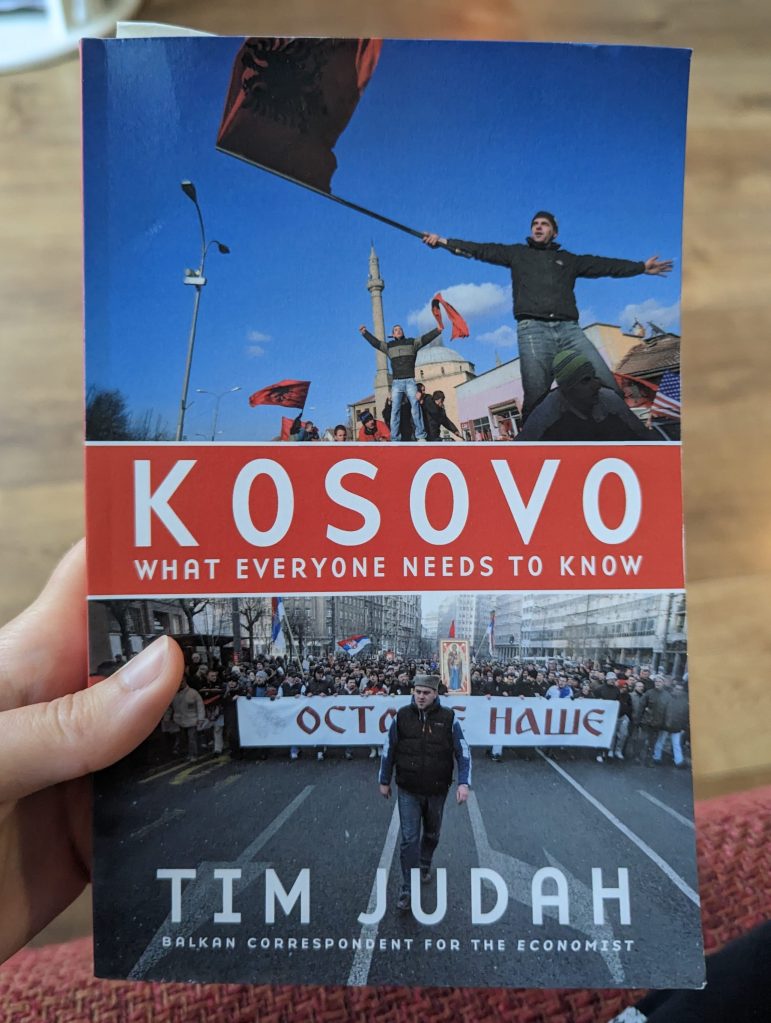
To learn more about Kosovo, I bought some books.
Language
The young people know English, the older people do not.
Albanian the most spoken language in Kosovo, so I have decided to try to learn some. The words and sounds are unfamiliar. Even people’s names are hard to pronounce, which makes their names hard for me to remember.
So far, I have learned a few Albanian words and phrases from the people I have met:
Albanian is a confusing language to me. The format is different, there are different dialects, and some of the sounds are very nuanced.
There are two major dialects of Albanian:
Gheg (pronounced: gig) is the dialect spoken in Kosovo, northern and central Albania, northwestern North Macedonia, southeastern Montenegro, and southern Serbia.
Tosk (pronounced: toesk) is the dialect spoken in Albania south of the Shkumbin River.
Tosk is the dialect taught in books, so those who know Gheg can understand Tosk, but those who know Tosk sometimes have trouble understanding Gheg. Geographically, Tosk is spoken in the big cities and flat regions and Gheg is more traditional and mountainous.
Here are some words I learned:
nëne = mother (pronounced: nuh-nah)
faleminderit = thank you (pronounced: fa-leh-mean-dare-eet)
shijoni = enjoy (pronounced: shee-owe-knee)
uyë = water (pronounced: oyuh)
birrë = beer (pronounced: bee-ruh),
Peja = a town in the northwest of Kosovo, also a brand of beer (pronounced: pae-uh)
mik = friend (pronounced: mick) *Tosk dialect
miq = friends plural (pronounced: mitch) *Tosk dialect
miq të mirë = best friends (pronounced: mitch-tuh-meer) *Tosk dialect
shok i mirë = best friend (pronounced: shuck-ee-meer) *Gheg dialect
shokë të mirë = best friends (pronounced: shoke-tuh-meer) *Gheg dialect
shihemi = see you later (pronounced: shee-hem-ee)
mirupafshim = goodbye (pronounced: mee-rue-poff-sheem)


 GoAmyGo
Leave a comment