Kosova, ending in an -a, is the Albanian name for the country. Kosovo, ending in -o, is the Serbian name and the accepted English name. The ethnic majority of Kosova is Albanian, being over 90%, with the next largest ethnic group being Serbian. Later in my trip, I will head to Albania; saying Kosova there is good. I don’t plan to head to Serbia on this trip, but if I were, they would prefer I say Kosovo.
About 100 countries recognize Kosova as a free and independent country from Serbia. Serbia does not recognize Kosova as independent and still considers it part of Serbia, “the heart of Serbia”. The other countries that do not recognize Kosova as independent have their own separatist regions that they are worried about trying for independence
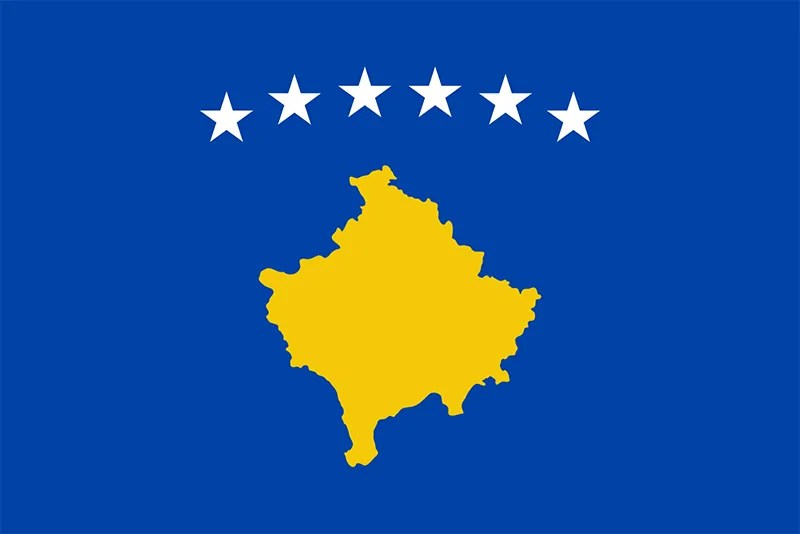
Kosova declared its independence in 2008. They had a public contest to design the Kosova’s flag. If you want to see some of the submissions, go to the flags of the world website. The eligible designs couldn’t contain or represent symbols from any other state, political party, movement or institution of Kosovo, or imply any allegiance to any ethnic community of Kosovo.
Albanian ABCs
The Albanian language has a lot of nuanced sounds that are in between sounds I am familiar with. Those tiny differences cause me a lot of difficulty: to me, the dh and th both sound like “th”, and the ç and q both sound like “ch”. Here is the Albanian alphabet.

Albanian is its own branch from the Indo-European family without any close language relatives. It is a very old language.
The “Learning Albanian in a short period of time” book is helpful as a vehicle for me to ask language questions to people. The book itself would not get me anywhere near to anything usable. There is a CD included, but I don’t have a CD player! I am enjoying carrying around the book to restaurant and coffeeshops and showing that I am trying, and then I ask a lot of questions!!!
Although I still don’t know many important tourist words, I am generally learning how to piece things together!
të dua = I love you (pronounced: tuuh-doo-ah)
të dua shumë = I love you very much (pronounced: tuuh-doo-ah-showm)
So… shumë means “very much / a lot”
I learned 3 different ways to say “good luck”:
paç fat = good luck (pronounced: pahch faht)
të uroj fat = good luck (pronounced: tuh-roit faht)
fat i mirë = good luck
So….
fat means “luck”
mirë means “luck”
And të makes it reflexive to “you”
Sometimes a word is treated differently if it is in a different location of the sentence.
si = how
emri = name
është = it is
Si e ke emrin? = What is your name?
Notice that emri by itself doesn’t have an “n” at the end, but if it is the object in the sentence, it gets an “n” at the end.
Some Albanian words sound like different languages to me.
As a whole, sometimes it sounds maybe French or Russian, but usually sounds like some something I’ve never heard before, because I haven’t!
- To me, this word sounds Spanish:
- çika = girl, the more common way to say in Kosova (pronounced: cheek, or chica)
- To me, this word sounds German:
- vajzë = girl, the more common way to say in Albania (pronounced: vise-uh)
- To me, this word sounds like Navajo (shout out Duolingo!):
- përshendetje = a formal greeting (pronounced: per-shon-date-yuh)
I am now on the bus to Prizren, Kosova – a town more southern, the cultural capital!
 GoAmyGo
Leave a comment