Seika’s parents brought me to have Okonomiyaki at their friend’s restaurant. Her parents, Akiko and Yasushi, speak as much English as I speak Japanese. It seems we all have been practicing a little. We are all impressed! Lots of stumbling through conversation, pantomiming, smiling, and Google Translate sometimes. It is a fun activiity.
Anytime I would ramble off a long paragraph into Google Translate, I would have the volume up so they could hear it, but I would also show them the written Japanese translation. They were frequently reaching for their reading glasses. We had such a great time.
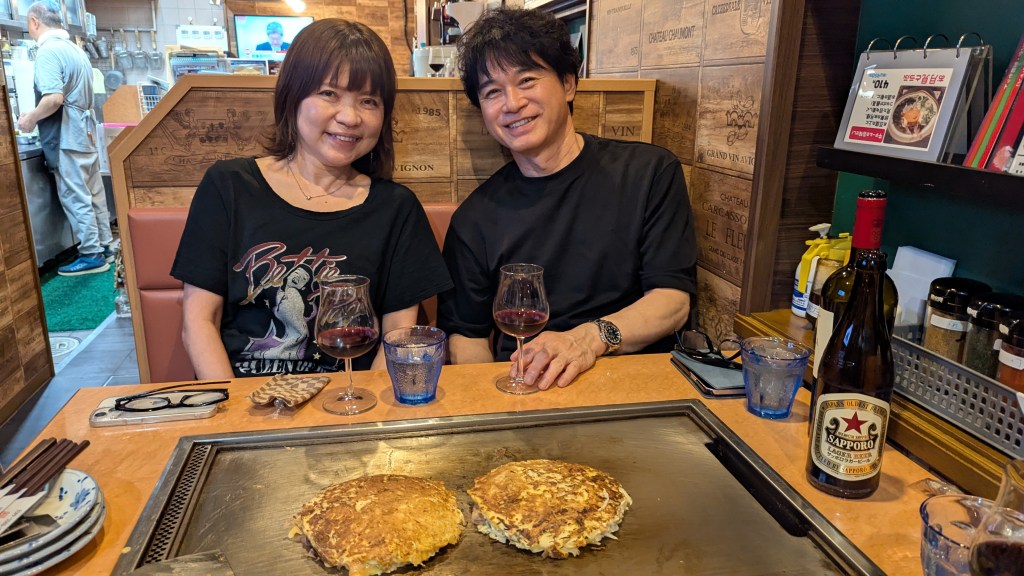
We ordered two different okonomiyaki, some yaki soba, and a tofu dish created in celebration of the お月見, (Otsukimi, Fall Moon Festival). I pronounce tofu like the American way “tow-foo”, but Akiko and Yasushi hardly pronounce the foo part. It sounds like “toph” when they say it.
I struggle to hear the difference between つ (Tsu) sound and す (Su) sound. So to me, (月, つき, tsuki, moon) and (好き, すき, suki, I like) sound so similar.
つき が 好きです (Tsuki ga sukidesu, I like the moon) is a silly sentence to me.
Here’s the dish with the egg yolk in it for the moon.

I am starting to pick up on the regional differences on how things are said. Takuro, who is from Tokyo, pronounces the word お茶漬け (ochazuke) like “o-chez-kay”, and Seika, who is from Osaka, pronounces it like “o-cha-zoo-kay.” It is a dish where tea is poured on top of rice. I didn’t try it, but I did buy some seasoning from the grocery store to try as a souvenier when I am back in America.
Seika’s parents are very patient with me and so funny and are helping me learn little things to help with my Japanese.
I was learning my direction words, and so far I have only been able to memorize “left” (左, hidari) and “right” (右, migi). The Japanese words for “forward,” “backwards,” and “straight ahead” didn’t have room in my brain this time. Next time!
Some words and phrases I was able to learn and also retain from Akiko and Yasushi’s and teachings:
- 良い1日を。(Yoi ichi-nichi o., Have a nice day)
- The word for castle is 城 (shiro), but Osaka castle is pronounced 大阪城 (Osaka-jo) because the suffix that means castle is “-jo.” Same type of thing with the word さかな (sakana, fish) has the suffix うお (-uo) like in カツオ (katsuo, bonito).
- どういたしまして。(Dōitashimashite., You’re welcome.)
- またね! (Mata ne!, See you!)
And there are a bunch of others that I will include in a later post with my complete dictionary of words I frequently used and learned.
Last time, I bought some Okonomiyaki ingredients to make it in America, but I have been too intimated to make it. Now seeing Seika make it at home and also tableside by Yasushi’s golf friend’s wife at the restaurant, I feel inspired to finally make it myself. Okonomiyaki is a savory pancake with cabbage and meat inside it and topped with sauce and mayonase. めちゃ 美味しい (Mecha oishī, Very delicious).
The restaurant-owning friends also brought us over some pieces of cheese and pickled raddish and japanese snacks! So nice! The pickled radish made such a loud crunchy sound when it was bitten into.
嬉しい! (Ureshii!, Happy!)
 GoAmyGo
Leave a comment